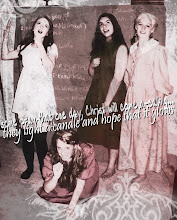
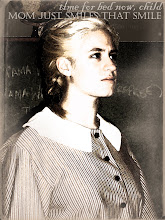
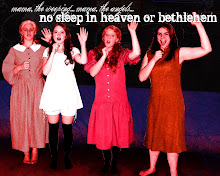
It’s the kind of autumn day where the sky and the temperature contradict each other, all sunshine and bitter wind, when Anna finally drums up the courage to visit Wendla’s grave by herself. She’s passed it countless times on her way through the village, walking to school with Martha and Thea, or going to church with her mama and papa, but she’s felt too shy to approach, to lay a flower in tribute, to reminisce about her friend.
Poor Wendla.
Everything has come apart at the seams since she’s been gone. Without the leadership she once had amongst their small group of friends, they all hang in the balance quietly, unsure of what to do, unsure of whether playing would be cruel to her memory, unsure of whether they should consider themselves girls or women now. Certainly they’re still treated like girls, but it seems that since everything else has changed, oughtn’t that to as well? There’s no more Melchi Gabor to fawn over while crossing the bridge, and Moritz is nothing but a topic of sad contemplation, though never when Martha is around.
Unmoored as they are, the three girls find themselves alone much more often. Thea’s clear-eyed innocence begins to feel cloying, and Martha withdraws into herself even more than before. Anna is unsure what to do: whether to step into Wendla’s old role or let her friends drift, although she feels responsible for them. She feels, in some ways, as if she’s betrayed Wendla by not coming by sooner: while surely her parents pay tribute, it seems as if most of the town has purposely forgotten her.
But Anna, who has never before experienced a loss this clearly or profoundly before, is unsure what the etiquette is. How does one visit a grave? Are you supposed to take flowers, or can you just go to remember them? She decides to take flowers anyway, just in case: some pretty white ones from her mama’s garden that she remembers Wendla loving. But there are so few, since it’s nearing winter, that the ones she finds seem paltry and hardly worth it.
Anything is worth it, she reminds herself. It’s still the thought that counts.
She goes to the graveyard after she’s finished her afternoon chores, promising to be home before supper, before it gets dark, so her mama won’t worry. Wrapping a shawl around her shoulders to keep the bracing wind from chilling her too much, she walks to the graveyard slowly, wondering what she’ll do there.
Once she’s arrived, she sets the blossoms down at the foot of the grave and kneels, thankful there’s no mud to muss her stockings up. She bows her head, as if to pray, and whispers, “I’m sorry I’ve waited so long, Wendla.”
She’d like to keep talking, to tell Wendla all of the ways things are so different now, but she holds back. She’s not sure if it’s proper to talk to the dead, and anyway if Wendla’s in heaven she’d certainly be able to see and know those things anyway.
A rustling, a set of footsteps – two sets of footsteps? – sound over Anna’s shoulder, and she whirls around to see who it is, her pigtails hitting her cold cheeks startlingly. She’s surprised to see Martha approaching, with her own handful of autumn flowers – but more surprised to see Ilse walking beside her, chatting companionably as the wind blows her loose hair about.
-B.
skip to main |
skip to sidebar





About Me


Blog Archive
-
▼
2008
(239)
-
▼
March
(40)
- I've got to get me out of here...
- I feel like Harry Potter.
- There's a moment you know... you're ******.
- The thing that makes you really jump...
- Quickly...
- actually back.
- Bop To The Top
- I hate Outlook.
- A FYI and a little rant of my personal disappointm...
- The companion to Wednesday's piece.
- Fiction from study hall. Expect more of this later.
- Nothings gonna happen...
- Alone on a Tuesday...
- A quick, illicit note from the land of awful compu...
- So I tried my best to change the colors back... So...
- I sort of miss the old colors, with C's posts just...
- 3rd Time...
- 3 days till my Birthday....
- So Sorry K
- The heart may freeze... Or it can burn...
- Let's put the weather on Xanax and Prozac and see ...
- Senior t-shirts...
- ZOMG! I hate drama...
- Managing.
- What's going on in my mind?
- I don't know what to say....
- Writing quickly before practice.
- What? Sunlight??
- Just let me be your Anna...
- NYC! I give you fair warning- up there, in lights ...
- Never UnderEstimate a good Peanut butter and Jelly...
- Wildflowers, chrysanthemums, roses...
- Closing time...
- Procrastination is such an ugly word.
- I'm kinda pretty, and pretty damn smart...
- Awful sweet.
- Such a sentimentalist...
- Where I go...
- Catch me I'm falling...
- Coming Back to Reality
-
▼
March
(40)